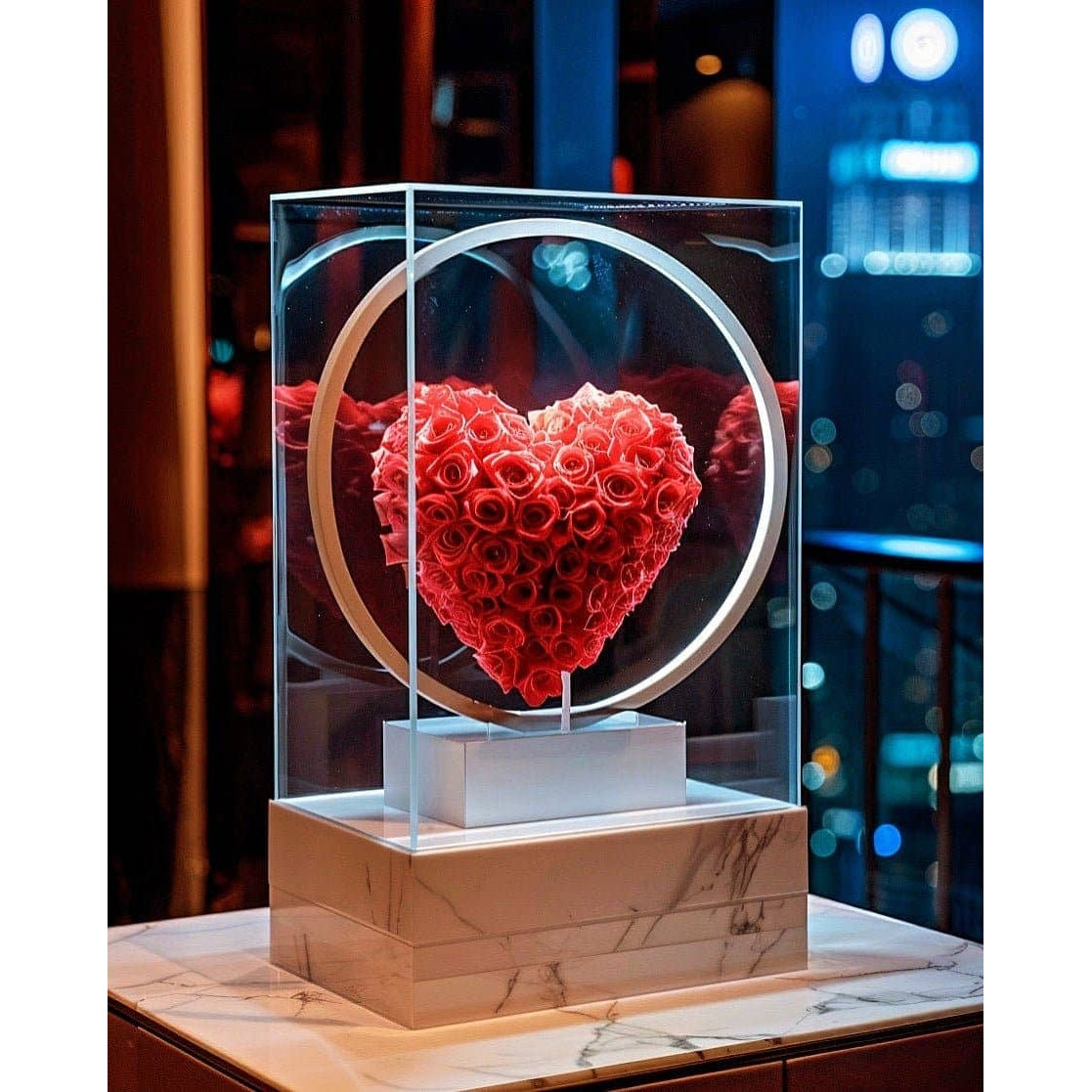
What happens when a floral form is designed not only to be seen, but to shape the light around it.
By Imaginary Worlds Editorial
Floral Art · The IW Journal
A preserved rose lamp is an illuminated object in which botanical material, structure, and light are designed together. The roses do not simply decorate a conventional lamp. Their repetition creates a surface; the supporting form establishes a silhouette; illumination changes how that surface is read after dark.
This distinction matters. The most interesting question is not whether a rose lamp can be labelled art, but what light does to the flower—and what the flower does to light.
Rose light after dark
The rose as a design medium
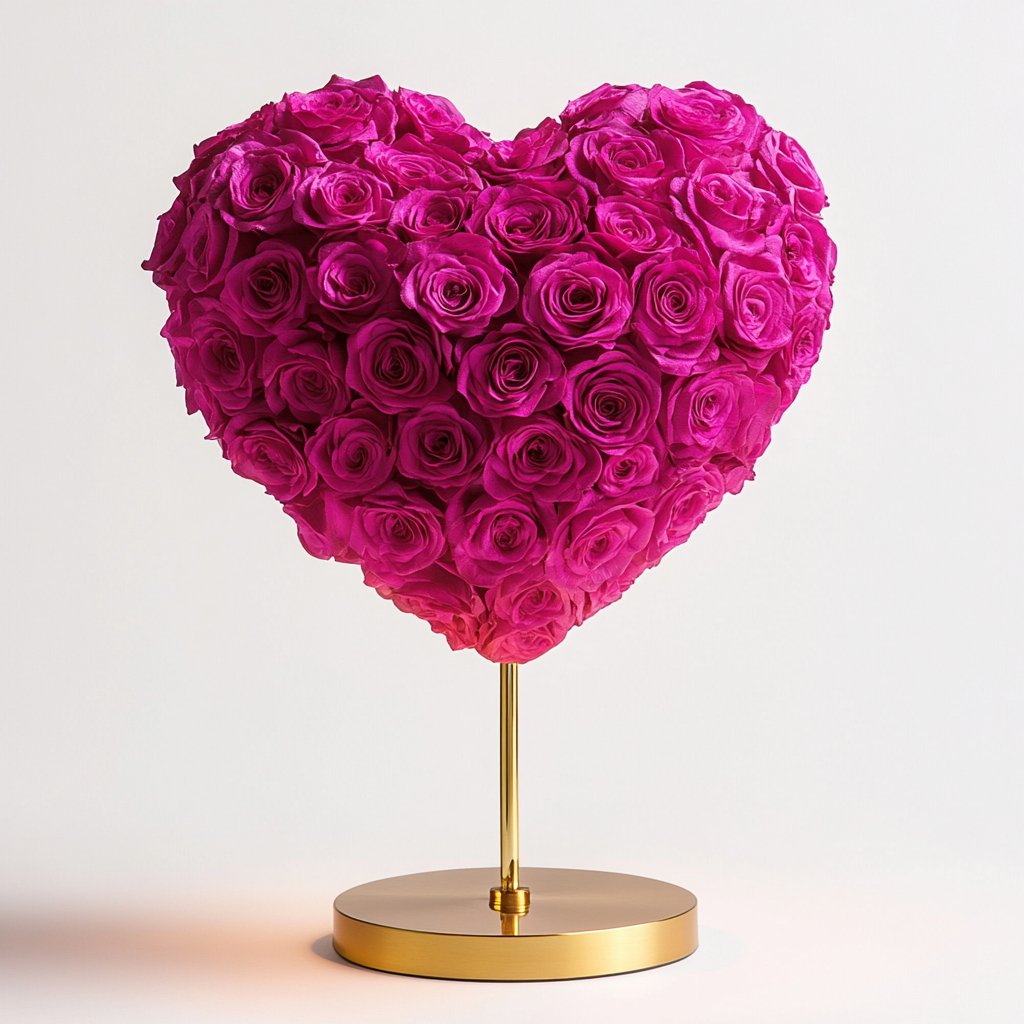
A cut flower ordinarily asks for water, a stem, and a composition that anticipates change. Preservation alters those constraints. The bloom can become a repeatable unit: petals build texture across a heart, sphere, letter, or figurative form while the overall geometry stays legible over time.
Repetition changes the meaning of one rose. A single bloom directs attention to botanical detail; many closely placed blooms form an almost continuous skin. From a distance, the viewer first reads the object. Up close, the object breaks back into individual flowers. That movement between whole and part gives preserved floral lighting much of its visual tension.
Light reveals more than color
In daylight, rose color and construction dominate. Under illumination, edges, gaps, shadows, and the translucency of petals become more apparent. Light may soften a saturated red, warm a pale pink, or turn the structure behind the flowers into a graphic outline. The same piece can feel precise by day and atmospheric at night.
Placement controls the effect. A bright room treats the lamp primarily as an object; a darker interior allows reflected glow to extend the composition onto nearby walls and surfaces. The work therefore includes its immediate environment. Scale, viewing distance, wall color, and competing light sources all affect the experience.
Four layers of an illuminated floral object
Botanical surface
Petal density, variation, and color establish texture at close range.
Sculptural form
The supporting geometry makes the object recognizable before individual roses are examined.
Illumination
Brightness and color temperature determine whether details sharpen, soften, or recede.
Setting
The surrounding room receives the glow and gives the object scale, atmosphere, and context.
Atmosphere and emotional symbolism
Flowers and light already carry their own symbolic histories. Roses can suggest affection, remembrance, devotion, or ceremony; light can suggest welcome, attention, guidance, or warmth. Bringing them together does not produce one fixed meaning. Instead, the object offers a vocabulary that can be made personal by shape, color, location, and the memory attached to it.
A heart form may be intimate, while a larger geometric or figurative form can feel closer to a collectible design object. Warm light can make the piece domestic and quiet. A dramatic night setting can emphasize outline and spectacle. Meaning comes from these choices rather than from a product label.
Heart-shaped preserved rose lamp
Designing the object
Successful composition depends on more than filling a shape with flowers. The maker must manage density, direction, edge definition, negative space, balance, and the transition between the floral surface and its support. Electrical elements and heat management also belong to the object, even when they are visually quiet. Only verified product documentation should be used to make claims about particular lighting technology, efficiency, or service life.
Preserved roses are especially suited to this language because the designed surface is not expected to transform over a few days. Yet preservation does not make the material permanent. Direct sun, humidity, heat, dust, and handling still matter, and any illuminated piece should be cared for according to its specific construction.
The lamp becomes most expressive at the threshold between object and atmosphere.
The Light Collection
Within Imaginary Worlds, The Light Collection explores this relationship at the scale of the personal interior. Preserved roses supply texture and emotional association; the form gives those roses an identity; illumination lets the object participate in the room rather than remain a static display.
The collection is best understood slowly: first by silhouette, then by the rose surface, and finally by the atmosphere that appears when the light is on. It is in that sequence—not in repeatedly calling the object art—that floral material begins to behave like light art.