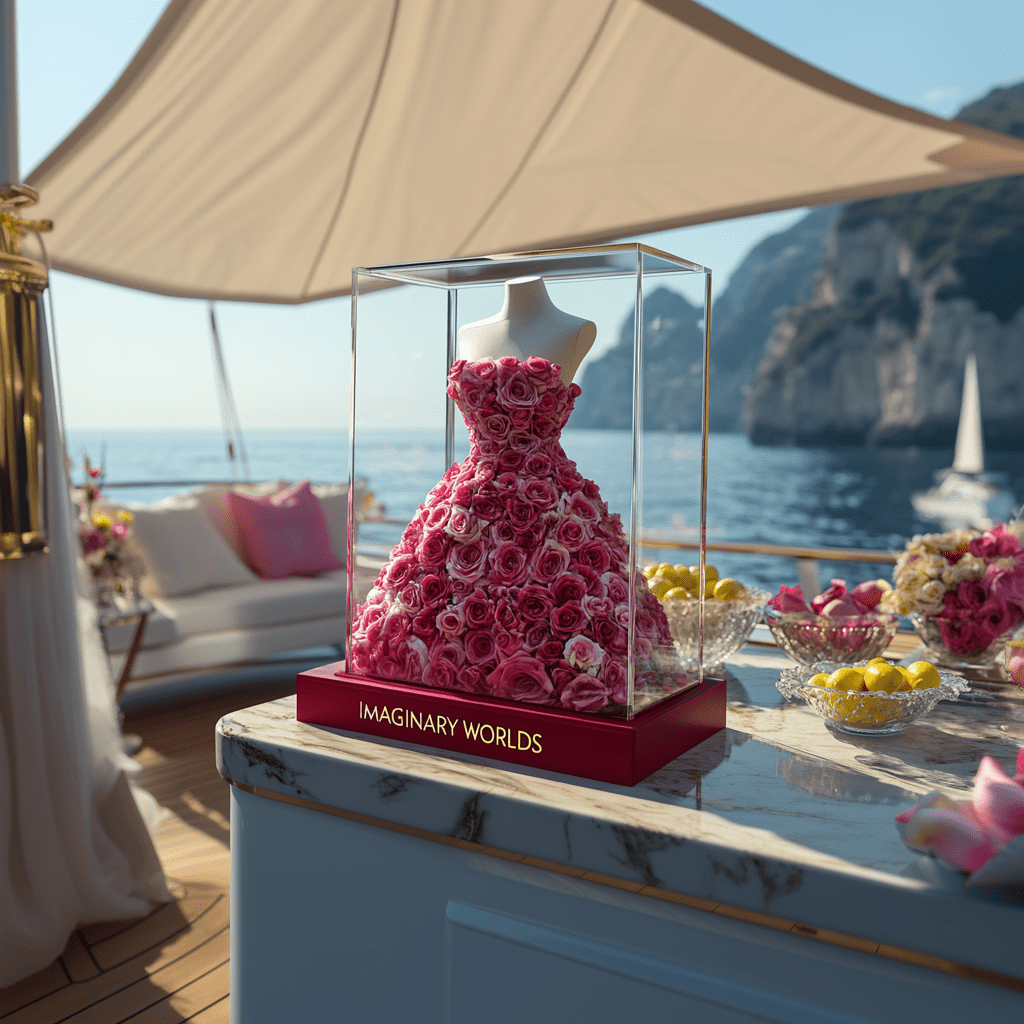
The dress as a site where botanical texture, silhouette, and imagined movement meet.
By Imaginary Worlds Editorial
Floral Art · The IW Journal
Flowers enter fashion in many forms: woven or printed motifs, embroidery, fabric petals, botanical accessories, fresh-flower garments, and sculptural objects built at the scale of a dress. Floral couture is a useful editorial phrase for this meeting, but it should not be treated as one official movement or a single documented lineage.
The preserved Rose Dress belongs at a particular edge of that field. It adopts the silhouette and visual drama of fashion while functioning primarily as a floral sculpture for display, not as a conventional garment claimed to have walked a runway or been worn in performance.
From motif to material
Fashion has repeatedly translated flowers rather than simply attaching them. A bloom can become pattern, color palette, seam line, volume, surface, or metaphor. Museum collections document painted and woven flowers, hand-made floral garnitures, embroidery, rosettes, and three-dimensional interpretations across periods and designers.
Using real botanical material changes the problem. Petals bring irregularity, fragility, thickness, and associations with scent and decay. The maker is no longer only depicting a flower; the flower itself becomes part of the construction or image.
Rose Dress in a coastal setting
Silhouette comes first
At human scale, the dress is recognized before the individual roses. Bodice, waist, skirt, train, symmetry, and stance determine whether the form feels architectural, romantic, ceremonial, or experimental. The floral surface must support that reading rather than blur every edge.
This is where couture thinking is useful even when the object is not wearable. A dress form organizes proportion around the body. It creates front, back, profile, balance, and imagined movement. Roses then behave like a dimensional textile stretched across that structure.
Four translations of flowers into fashion
Image
Flowers appear as print, painting, photograph, or woven motif on cloth.
Embellishment
Fabric, artificial, dried, or real flowers are attached to a wearable base.
Construction
Petal-like layers, folds, and volumes shape the garment even when no literal flower is present.
Floral sculpture
Botanical material covers or defines a garment-scale structure primarily intended for image, installation, or display.
Temporality and preservation
Fresh floral fashion carries an extraordinary immediacy. Its material may wilt during preparation, photography, or performance, making time part of the work. Preservation changes that relationship. Roses can be composed more slowly and the completed surface can remain available for repeated viewing.
The exchange is not neutral. A preserved flower loses some living scent, movement, and transformation. It gains stability and a longer design horizon. The object still ages, as every garment and botanical material does; preservation moderates change rather than defeating it.
Construction behind the image
A convincing Rose Dress begins with support. The structure must carry floral weight, maintain proportion, survive movement between locations, and create clean transitions at neckline, waist, hem, and any openings. Bloom placement then establishes rhythm and continuity across a complex three-dimensional surface.
Color can flatten or model the silhouette. One hue emphasizes outline and texture; gradients can suggest folds; contrast can define a bodice or train. Density must be calibrated so the structure disappears where intended without making the form heavy and visually undifferentiated.
Display is part of the work
A case protects the delicate surface and signals that the object is to be viewed rather than worn. A plinth, room, camera angle, and lighting determine its perceived scale. Fashion-editorial photography can restore an imagined body through framing and atmosphere, while gallery presentation emphasizes sculpture and material.
Neither mode should imply events that did not happen. An image can evoke a runway, atelier, or exhibition without being evidence of one. Clear captions preserve the distinction between art direction and documented history.
The Rose Dress borrows fashion's silhouette and sculpture's stillness, then lets flowers occupy the space between them.
The Couture Collection
Within Imaginary Worlds, The Couture Collection explores dress and fashion-object forms through preserved roses. Its strongest future development will depend on media that shows construction, full human scale, side and back views, and carefully directed environments—not only a single frontal product image.
Floral couture becomes convincing when the flower changes how fashion is seen, and the garment form changes how the flower is understood. The aim is not to claim a fashion-house history, but to build a visually literate practice at the intersection of botanical material, image, and sculptural form.